Every 20 years, the Electoral Wards Commission revises our local ward boundaries. There was a new consultation last year. Changes are needed because of the expanding population: Camden Borough proposes to build 1000 new homes a year (and rebuild others) through until 2030.
This is the map of Camden Town estate when it was being built in 1850.
Camden Estate map (London Metropolitan Library)
Here are ward boundaries from earlier periods:
In the consultation last year, Rochester Conservation Area recommended two wards, of Camden Town and Cantlowes. Wards are expected to be about 10 000 population, so two were needed – called Cantlowes and Camden Town.
Instead, the Electoral Commission’s proposals, with the Council’s support, will divide Camden Road, with Rochester put into ‘Kentish Town South’; change Cantlowes, the historic name, for ‘Camden Square’; put ‘Camden Town’ at Chalk Farm Road; and call old (south) Camden Town ‘St Pancras & Somers Town’.
Electoral Wards proposed (red) Camden Town estate (blue)
There has been very little interest from local councillors about the changes proposed for central Camden. Why has Rochester Terrace Gardens been separated from Rochester Square? How will fifteen councillors discuss the needs of Camden Town?
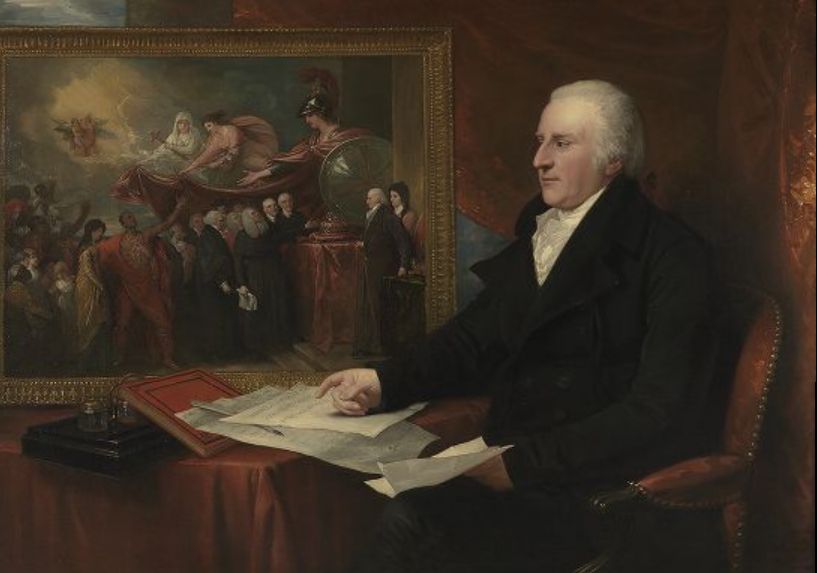
I went to New Haven, Connecticut, the home of Yale University, to see the Portrait of John Wilmot and hear a lunchtime public talk by a student gallery guide, Adam Chen. He described the representation of Wilmot as Commissioner for compensation for British losses in the American War of independence up to 1783. The portrait is hung in the Long Gallery at the Yale Center for British Art. Opposite, looking across at it, is a full-length portrait of its painter, Benjamin West, President of the Royal Academy of Arts.
I was able to read correspondence between the painter, West, and the sitter, Wilmot, that are held at Yale Library. Wilmot didn’t want just a portrait for his family, but rather a celebration of the loyalty of those British subjects who remained loyal to the Crown rather than join the American revolution. West, originally from Philadelphia, who had become the Royal History Painter, responded with the portrait and allegory in one painting (January’s blog).
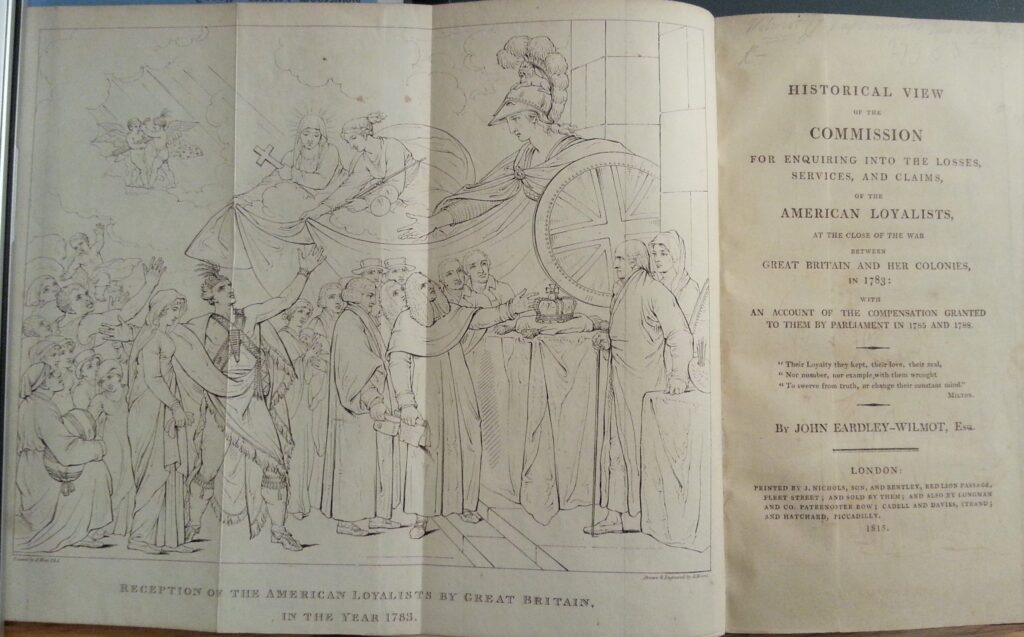
Frontispiece by Benjamin West to Wilmot’s Historical View of the Commission
The engraved Allegory (above) became the frontispiece to Wilmot’s book about the Commission . It was called ‘an outrageously self-serving fiction’ by Simon Sharma, in his book Rough Crossings about the experience of British blacks after Independence, because Britain did not give financial compensation equally to the different groups represented in the picture. Yet from the West/Wilmot letters, the picture’s purpose was to show loyalty rather than compensation: West brought women and children, commoners, blacks and a Native American all into the picture.
Wilmot’s portrait has a parallel with contemporary history. In 2019, Britain had a (non-military) rebellion against the European Union, the vote for Brexit. The ‘Remainers’ in Britain, and also those living in other European countries, feel let down by politics in the same way as the loyalists were. This time, there’s no financial compensation being voted by Parliament. Yet it’s unlikely that the President of the Royal Academy will make a portrait of Sir Kier Starmer, who led the Labour party opposition within Parliament; it is more likely that the losers will be forgotten.
West’s portrait of Wilmot has much British political history in it. It is sad that it was sold to Paul Mellon in 1970 and moved to America, rather than being in the London National Portrait Gallery. But there’s a small story to give a smile. The American State Department asked Mellon if it could be loaned the picture for its Diplomatic Reception Rooms.1 They believed – because of misattribution in the Auction catalogue – that the picture was ‘another version’ of Signing of the Peace between Britain and the United States that West had painted in 1783. But the Portrait of John Wilmot is a strong statement of loyalty to King George III – hardly the symbolism for the US Diplomatic Reception Rooms.
1 Correspondence held at the Yale Center for
British Art
The portrait of John Wilmot (1750-1815), painted by Benjamin West, the president of the Royal Academy, in 1812 hangs in the Yale Center for British Art at Yale University, New Haven, USA. There’s to be a talk about the picture at Yale next month.
Portrait of John Wilmot by Benjamin West, 1812 (Yale Center for British Art, USA)
The portrait was one of West’s only two paintings at the 1812 Royal Academy exhibition and was noted for including history (the Allegory of Britannia welcoming American Royalists) as well as the person of Wilmot. How the painting was first made, and what happened to it between being shown in 1812 and being sold at auction in London in 1970, are open to discussion.
The Wilmots, lawyers and back-bench politicians, had connections with the Camden Town estate. John Wilmot (or as he became John Eardley-Wilmot) was known to Joseph Kay, the Camden Town estate’s main architect, through shared connections with the Foundling Hospital in Bloomsbury.
Sir John Wilmot had followed Sir Charles Pratt (as Lord Camden was once) as Lord Chief Justice of the Common Pleas. John Wilmot’s son, Sir John Eardley-Wilmot, 1st baronet, and then his son, Sir John Eardley-Wilmot, 2nd baronet, were both friends of the Pratt family – there’s correspondence in the Pratt family archives, showing they visited each others’ houses in Malvern and Sevenoaks respectively.
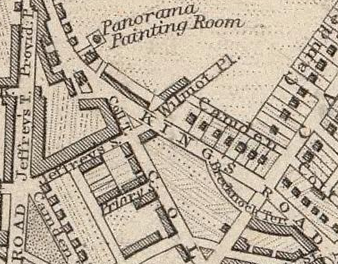
These connections may explain the naming of Wilmot Place, a turning off St Pancras Way near Camden Road. Otherwise, it’s an anomaly – almost the only street not named after the estate’s original landlords, the family of the Lords Camden or the prebend of St Paul’s Cathedral.
1843 map showing origin of Wilmot Place
Two alternative explanations of why the road was named Wilmot are probably false – that it was the John Wilmot poet, Lord Rochester of the seventeenth century (who has no historic connection) or that it was the local builder (who was actually George Lever).
I found unexpectedly a week ago that there was a current consultation on changing the electoral ward boundaries in Camden.
I have made the case for Camden Town and Cantelowes wards to reflect more closely the Lord Camden’s estate, rather than the looser proposals of the Electoral Boundaries Commission.
My submission is here – and should in due course also be on http://www.lgbce.org.uk/all-reviews/greater-london/greater-london/camden
I’m grateful to friends locally who have also written to the Commission
This month, Camden borough held a conference, A hundred years of council housing’. Its theme fits with my August blog describing the 1919 sell-off of parts of the Camden Town Estate. The government’s policy after the First World War was to build housing with public funds, providing employment and homes for returning soldiers as well as redirecting industry from war production. Camden Town was only lightly affected at the start of this period, with the mansion blocks of Highstone in Camden Road in the interwar period. But there was much more serious rebuilding happened after the Second World War, beginning with the St Pancras Way estate and then in the 1950s and 1960s when properties owned by the Church of England, around Camden Street, were sold to St Pancras borough.
Was rebuilding for ‘poor housing’ or ‘housing the poor’? Both – and they were linked. The first streets of Camden Town were set out east of the High Street in the 1790s. The main contractors, Kirkman and Hendy, had taken a large lease but after four years went bankrupt. Partial leases passed on their creditors, who slowly sold on to new builders. Under less control from the Camden Town Estate, some builders put up cheaper houses, without front areas and with small back gardens: they could be afforded by poorer people, but became overcrowded; and with shortish leases before redemption, there was little incentive for improvement by the owners.
Any London Street, Richard Nevinson, 1920s.
I’ve recently come across this painting by Richard Nevinson which he titled Any London Street. Nevinson had been a friend of Walter Sickert at the time of the short-lived ‘Camden Town Group’ (1911-1913), but fell out with him and most of the rest of the art establishment. Although he is now remembered particularly for his paintings at the front in the First World War, during the 1920s Nevinson painted different aspects of London including street scenes. This painting, showing the work of women and the road as playground for children, has no specific location yet could well be Camden Town (see Museum of London and Tate Gallery). Nevinson included an etching of it as an illustration in his autobiography Paint and Prejudice (1937). The original oil painting sold for £63000 in 2011 at Sothebys.
It has been easier in Camden Town Local History to recall the architecture and development of Camden Town than it has been to recall the lives of people. Nevinson’s portrayal is festive, pedagogic, humane – as successful as the words of an historian.